Project Summary
Project Name
How We Developed Iridescent Vacuum-Plated Perfume Bottles for a $220,000 Luxury Beauty Brand
Country
United Arab Emirates (الإمارات العربية المتحدة)
Client Identity
Purchasing Representative
Order Amount
$221,020.00
Order Quantity
55900
Project Year
2019
Service Scope
Development of innovative surface treatment processes, Custom manufacturing, Compliance support, Project management, Logistics Services
Client Reviews
"HUIN not only flawlessly executed the iridescent vacuum-plating and precision laser engraving but also solved the challenge of product weather resistance in high-temperature environments. Having a dedicated account manager throughout the process made communication exceptionally smooth. The successful launch of this new product is a testament to your professionalism and reliability—thank you!"
Background
In 2019, the Middle East beauty market was heating up with a surge in demand for high-end products. Clients raised their standards significantly regarding the visual texture and customization of packaging materials. Additionally, the region's hot, arid climate imposed strict requirements for weather resistance. Amidst this, the vacuum-plated iridescence process was just emerging (with few suppliers mastering the technique), and the client sought to enhance product competitiveness through this innovative process. The client was a high-end beauty company deeply rooted in the Middle East market for 20 years, specializing in premium skincare and fragrance lines.
Client Requirements
Secure and execute a $220,000 order for glass perfume bottles utilizing a composite process—vacuum-plated iridescence, precision laser engraving, and internal water-based pearlescent coating (an emerging technique in 2019). Objectives included: obtaining Middle East environmental certification; meeting strict quality standards (gradient iridescent gloss ≥90%; laser engraving line width of 0.12mm with no burrs; abrasion resistance ≥Grade 5; compliance with weather resistance standards; defect rate ≤1.5%); completing delivery within four months; assigning a dedicated account manager to ensure smooth communication; controlling the unit price between $3.80 and $4.10; reducing the client's end-user return rate to below 2.5%; overcoming challenges such as lagging R&D, poor weather resistance, and frequent account manager turnover; and ultimately supporting the launch of the client's new product, boosting competitiveness, and establishing a long-term partnership.
Requirements Analysis
1. Analysis of Client Pricing Requirements: The client targets the high-end Middle Eastern beauty market. Their core requirements are "novel manufacturing techniques + high weather resistance + seamless communication." They have low price sensitivity and an ample budget ($3.8–$4.1 per unit). The primary objectives are to achieve product differentiation and a luxurious feel through the novel technique of vacuum-metallized iridescent coating; minimize return losses by enhancing weather resistance; reduce communication costs by assigning a dedicated account manager; and ensure a successful product launch to capitalize on growth opportunities in the Middle East's high-end beauty market. 2. Competitor Price Analysis: In 2019, the industry average price for similar glass perfume bottles—featuring vacuum-metallized iridescent coating, fine laser engraving, and internal water-based pearlescent coating—ranged from $3.9 to $4.2 per unit (reflecting the limited number of competitors who had mastered the nascent vacuum-metallized iridescence technique). After calculating costs, we proposed an initial price of $4.05 per unit, falling within the client's budget range. Our strategy emphasized our R&D capabilities for novel techniques, expertise in optimizing weather resistance, and dedicated account management services to differentiate ourselves from competitors. 3. Cost Structure Breakdown (Multi-factor Calculation): Raw materials (high-clarity flint glass) 44%; vacuum-metallized iridescent coating (gradient iridescence, vacuum level ≤ 2×10⁻³ Pa) 18%; fine laser engraving (high-precision laser equipment) 15%; internal water-based pearlescent coating (weather-resistant formula) 12%; certification costs (Middle East environmental compliance) 3%; logistics and taxes (dedicated Middle East shipping line, heat-resistant packaging) 6%; and reasonable profit margin 2%. 4. Core Challenges: Mastering the novel vacuum-metallized iridescence (gradient effect) technique while ensuring consistent gradient quality and luster; optimizing the internal coating formula to enhance weather resistance for the hot, arid Middle Eastern climate; assigning a dedicated account manager to establish a seamless communication mechanism; delivering approximately 54,000 units (based on the initial quote of $4.05/unit) within four months while balancing process precision, weather resistance, and delivery schedules; and successfully negotiating and reaching a pricing consensus with the client to facilitate the product launch.
Action
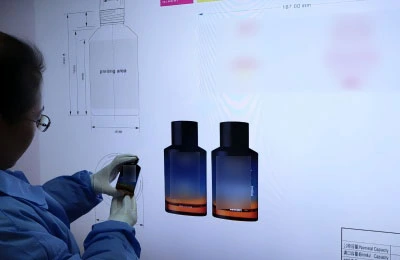
1. Pre-sales Follow-up: The follow-up process spanned 1.5 months with 12 total interactions—comprising four video conferences and eight email exchanges. We proactively assigned a dedicated account manager—fluent in Arabic and well-versed in the Middle East market—to serve as the single point of contact throughout the process, ensuring seamless communication and continuity. We facilitated direct collaboration between our teams and the client’s design and quality control departments to precisely align on manufacturing specifications, weather resistance standards, certification requirements, and pricing parameters. We also showcased our capabilities by presenting case studies on our innovative manufacturing processes and weather-resistance testing results. To address the Middle East's hot, arid climate, we proactively developed a weather-resistant internal coating formula and conducted rigorous high-temperature testing to ensure the product met all durability standards. 2. Price Negotiation (Value Delivery + Value-Added Service + Win-Win Solution): The client had initially received quotes from three competitors ($3.95, $4.00, and $4.15 per unit) and questioned our quote of $4.05 per unit, requesting a reduction of $0.05. They also demanded a guarantee that the dedicated account manager would remain unchanged throughout the project, stipulating a penalty (calculated at 3% of the order value) for any personnel changes. They indicated that if these terms could not be met, they would consider the supplier offering the $4.00/unit quote. We structured our communication around the client's core concerns to achieve a win-win outcome: Step 1: We openly addressed the price difference—specifically the $0.05/unit gap—by explaining the additional investments we made in new process R&D, weather-resistance optimization, and dedicated account management. These investments—such as the $80,000 spent upgrading vacuum-metallized iridescent coating equipment, developing weather-resistant internal spray formulas, and allocating extra personnel for a dedicated account manager—were all aimed at meeting the client's core needs. Step 2: We reframed the value proposition using data. We demonstrated the financial losses incurred with the existing supply chain—stemming from outdated technology, poor weather resistance, and frequent account manager turnover—which totaled $300,000 ($120,000 in breach-of-contract penalties, $150,000 in return losses, and $30,000 in increased communication costs). We showed how our commitment to meeting process and weather-resistance standards, combined with a fixed dedicated account manager, could help the client avoid these losses, ensure a smooth product launch, and recoup earlier deficits. Step 3: We conducted an objective comparison, highlighting the shortcomings of the supplier quoting $4.00/unit: mediocre vacuum-metallized iridescent gradient effects and weather resistance (struggling to withstand the Middle East's high temperatures), frequent account manager turnover, and high communication costs. We pointed out that choosing that supplier could still lead to return losses, communication headaches, and delays in the new product launch. Step 4: We proposed a compromise: adjusting the price to $4.02/unit while committing to: ① providing 1,200 spare units free of charge (valued at $4,824); ② assigning a fixed dedicated account manager for the entire project duration, with a penalty of 3% of the order value payable to the client should a change occur due to our actions; ③ offering free advice on product weather-resistance maintenance to extend product lifespan; and ④ absorbing exchange rate fluctuations within a ±3% range, with any variance beyond that shared equally (50/50) between both parties. After three rounds of discussions (spanning eight days and six separate interactions), the client recognized the value, sincerity, and service guarantees we offered; they accepted our proposal and signed the order. 3. Technical R&D and Process Optimization: A dedicated R&D team (7 members) was assembled to develop a new vacuum-plated iridescent finish. The team upgraded vacuum coating equipment and optimized coating parameters—including vacuum level, temperature, gas ratio, and coating duration—while employing multi-target gradient coating technology. After 22 trials, a gradient iridescent effect with a gloss level of ≥90% was successfully achieved. For precision laser engraving, high-precision equipment was used to optimize parameters, ensuring a line width of 0.12 mm with no burrs or edge chipping. Regarding the internal coating process, a proprietary weather-resistant water-based pearlescent paint formula was utilized; a curing step (140°C for 30 minutes) was added to enhance the coating's weather resistance. Following rigorous high-temperature testing (30 days at a constant 45°C), the coating showed no cracking or peeling and achieved a friction resistance rating of Level 5.2. 4. Sample Coordination: Based on the developed process and client design requirements, four batches of samples (40 units per batch) were produced, with the client paying a $2,200 deposit. To address issues identified in the first batch—specifically uneven gradient iridescence and minor laser engraving burrs—coating and engraving parameters were optimized, and the frequency of sample spot checks was increased. The final samples passed both client and third-party inspections; all metrics met client specifications, weather resistance standards were satisfied, and the client formally approved the product. 5. Production and Communication Management: Optimized production workflows and implemented a "three-tier inspection system" (process inspection, batch inspection, and finished product inspection), with random sampling of 400 units per batch; key inspection criteria included the iridescent gradient effect, laser engraving precision, and the weather resistance and gloss of the coating, with immediate rework for any non-conforming products. Efficiently managed two production lines using a 12-hour shift system and a 3-day buffer period to ensure delivery within four months. Utilized heat-resistant packaging to prevent coating damage caused by high temperatures during transit. Assigned a dedicated client liaison to provide daily progress updates and timely information regarding production, samples, and logistics; addressed client requests for process modifications with solutions within 24 hours to prevent communication gaps or information errors. Established a real-time production reporting mechanism, submitting weekly reports to keep the client fully informed of progress. 6. Certification Follow-up: Assigned dedicated personnel to manage the environmental certification application for the Middle East; compiled product test reports, weather resistance reports, production process documentation, and eco-friendly material certifications. Successfully obtained certification in just 40 days—meeting market entry requirements and reducing the certification timeline by 20% compared to industry peers.
Results
(Data calculated based on client feedback and documentation)
1. Quality and Compliance Outcomes: Delivered a total of 55,900 units, comprising 54,700 conforming glass perfume bottles and 1,200 complimentary spares. The vacuum-plated iridescent gradient effect was uniform with a gloss level of 91.3%; fine laser engravings averaged 0.11mm in line width with no burrs; the internal water-based pearlescent coating achieved a friction resistance rating of Level 5.2 and met weather resistance standards (showing no cracking or peeling after 30 days at a constant 45°C). The defect rate was 1.2%, falling below the client's 1.5% limit; the product successfully obtained Middle East environmental certification, fully aligning with local market requirements. 2. Returns and Cost Outcomes (figures based on customer feedback and records): The customer's end-user return rate dropped to 1.8%—a 5.5 percentage point decrease compared to the previous supply chain—saving the client $115,000 in return-related losses alone. Our quote of $4.02 per unit fell within the client's budget, resulting in a total cost of ownership saving of approximately $265,000; this helped reduce costs and increased profit margins for the product. 3. Delivery and Communication Outcomes: Deliveries were completed on schedule with zero delays, ensuring the successful launch of the client's key new product and recouping $120,000 in potential penalty fees caused by earlier delays. Following the launch, the product—featuring a unique iridescent vacuum-plating finish—received an enthusiastic market response, with sales volume increasing by 40% compared to the previous generation. A dedicated account manager handled the project from start to finish, ensuring timely responses; this eliminated the need for the client to restate requirements, reduced communication costs by 70%, ensured error-free transmission of technical details, and significantly boosted customer satisfaction.

Have a Similar Procurement Project?
Our team has rich experience in custom production, able to provide one-stop solutions from design, proofing to mass production.