


Blankets suit stationary use. Vests are stronger when mobility matters.
Product & Category Insights
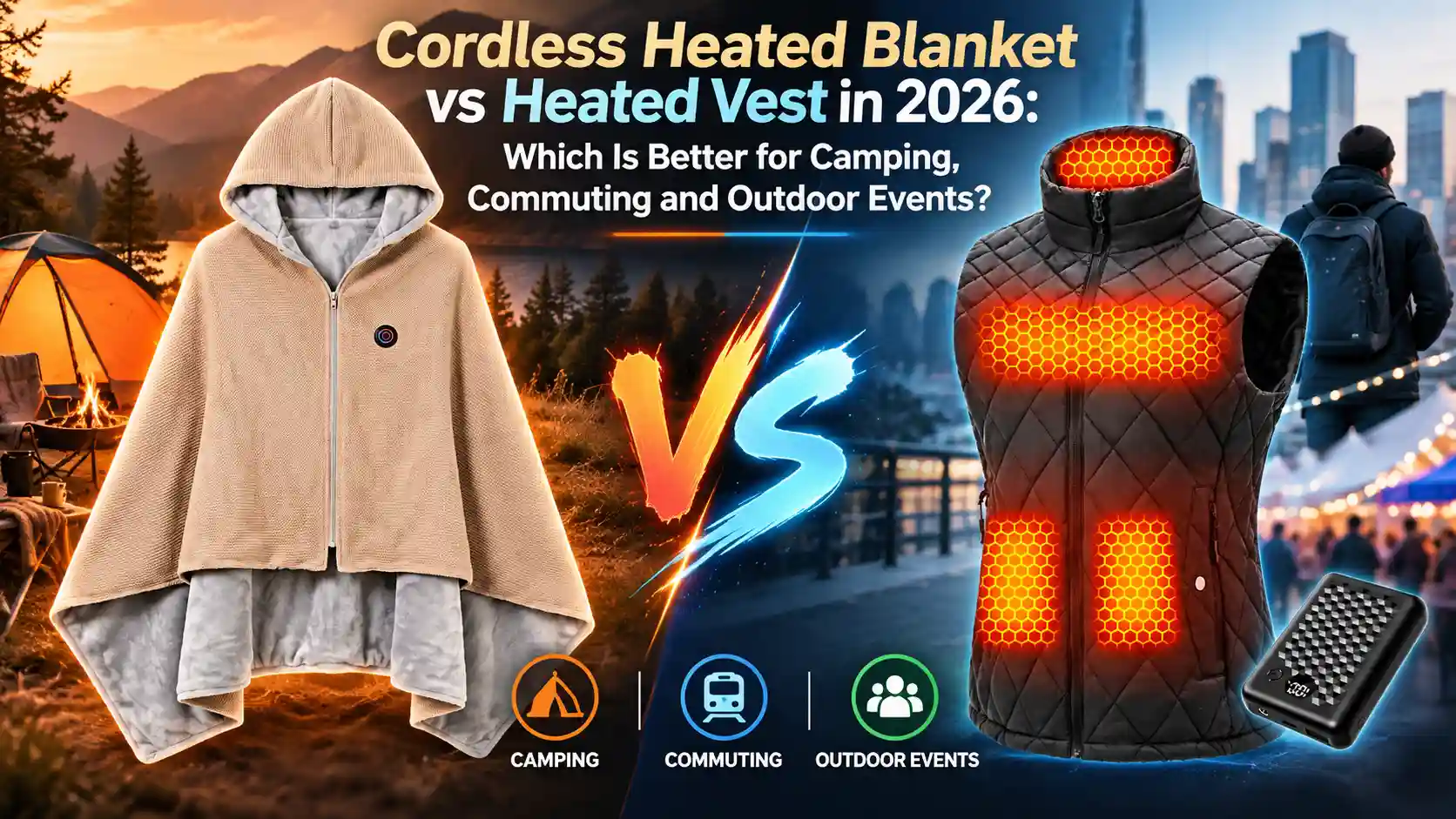
Cordless Heated Blanket vs Heated Vest in 2026: Which Is Better for Camping, Commuting and Outdoor Events?
2026-09-30By HUIN Team
Compare cordless heated blankets and heated vests by warmth, battery life, heating zones, mobility, safety and travel use for camping and outdoor activities.
2026 Portable Heated Gear Guide
Cordless Heated Blanket or Heated Vest? Start With How You Actually Use It.
Battery-powered blankets and heated vests can both create portable warmth, but coverage, mobility, battery efficiency and real-world comfort depend on very different design choices.
Executive Summary
The best heated product is not automatically the one with the highest temperature, largest battery or most heating zones. Start with the activity, then evaluate the complete heating system.
Heating-panel size and position matter as much as the number of zones.
Watt-hours and power consumption tell more than mAh alone.
Heating elements, wiring, battery protection and wash durability all matter.

Portable Heat Is Becoming More Useful Than Simply Wearing More Layers
Traditional cold-weather clothing mainly reduces heat loss. Battery-powered heated gear adds active heat directly where the user needs it.
That makes portable heated products useful for camping, sporting events, commuting, office work, outdoor work, travel and other situations where the user may remain exposed to cold for long periods.
But heated blankets and heated vests solve different problems.
The Better Buying Question Do you need broad warmth while staying relatively still, or targeted warmth that stays attached to your body while you move?
Answer that question before comparing battery capacity or maximum temperature.
What a Modern Cordless Heated Blanket Can Look Like
A current product in this category combines nine heating areas, three selectable temperature levels, a removable 5V 10,000mAh power bank and a wearable design that can be placed across the shoulders, back or lap.
It also uses a battery pocket to organize the power source and allows machine washing after the battery has been disconnected and removed.
Heating Panels Controller USB Connection Power Bank Insulated Textile
A heated product should be evaluated as one thermal system—not as a battery, fabric and heater considered separately.
1. Heated Blanket vs Heated Vest: Start With Movement
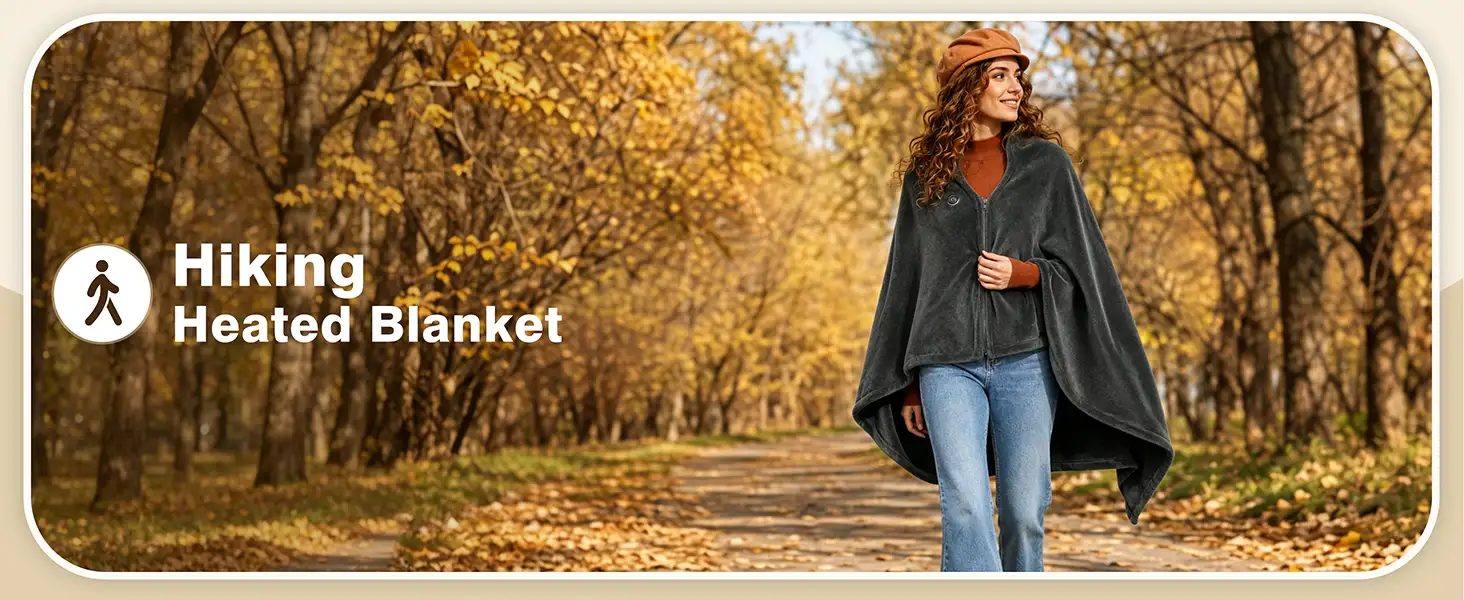
Best suited to stadium seating, camping chairs, offices, patios, vehicle passengers and other situations where broad flexible coverage matters.
Better suited to commuting, outdoor work, walking and activities where heating elements need to remain positioned against the torso.
A blanket can cover shoulders, back, lap or legs depending on how it is positioned.
A vest offers less total coverage but keeps the heating areas in a much more consistent position during movement.
Sitting still for hours favors coverage. Moving frequently favors wearable heat.
2. More Heating Zones Do Not Automatically Mean More Warmth
Heating-zone count is easy to advertise but difficult to evaluate without knowing the physical size and location of each heating element.
How many separately positioned heating sections are used?
How large is the actual heated surface rather than the surrounding textile?
Are heaters located where the intended user actually needs warmth?
Nine small heating pads can provide less total heated surface than six larger panels.
For blankets, useful areas may include the shoulders, upper back, lower back and lap. For vests, heater placement is usually more valuable around the torso, back and sometimes the neck.
Compare heated area and heater placement—not only the number printed on the product page.
3. Maximum Temperature Is Not the Same as Thermal Comfort
A common three-level system in this category uses approximately the following temperatures.
| Setting | Approximate Temperature |
|---|---|
| Low | 95°F / 35°C |
| Medium | 113°F / 45°C |
| High | 131°F / 55°C |
But temperature alone does not determine how warm the user feels.
Thermal comfort is also affected by ambient temperature, wind, insulation, contact area and the user's activity level.
A moderate heater protected by an insulating outer layer may be more effective than a hotter heating panel exposed to continuous wind.
4. Battery Capacity: Stop Comparing Only mAh
Battery-powered heated products are often compared using milliamp-hours.
A more useful unit for total stored electrical energy is watt-hours.
Battery Energy Watt-hours = Voltage × Amp-hours
10,000mAh = 10Ah
But mAh alone is incomplete unless the relevant battery voltage is also known.
This distinction matters because the heating system consumes power in watts.
If a battery is labeled 37 Wh and the heating system averages 10 W, a simplified theoretical estimate would be:
37 Wh ÷ 10 W = 3.7 hours
Actual runtime will differ because of conversion losses, heater cycling, battery temperature and operating conditions.
5. Why “Up to 8 Hours” Can Be Misleading
Runtime claims have little meaning unless the test conditions are known.
Low heat consumes less energy than maximum heat.
Battery performance and heater demand can change in very cold conditions.
Age, charge level and battery quality all affect usable runtime.
A useful product specification should state runtime for low, medium and high heat under defined test conditions.
A repeatable four-hour result is more valuable than an eight-hour claim nobody can reproduce.
6. Which One Is Better for Real Cold-Weather Activities?
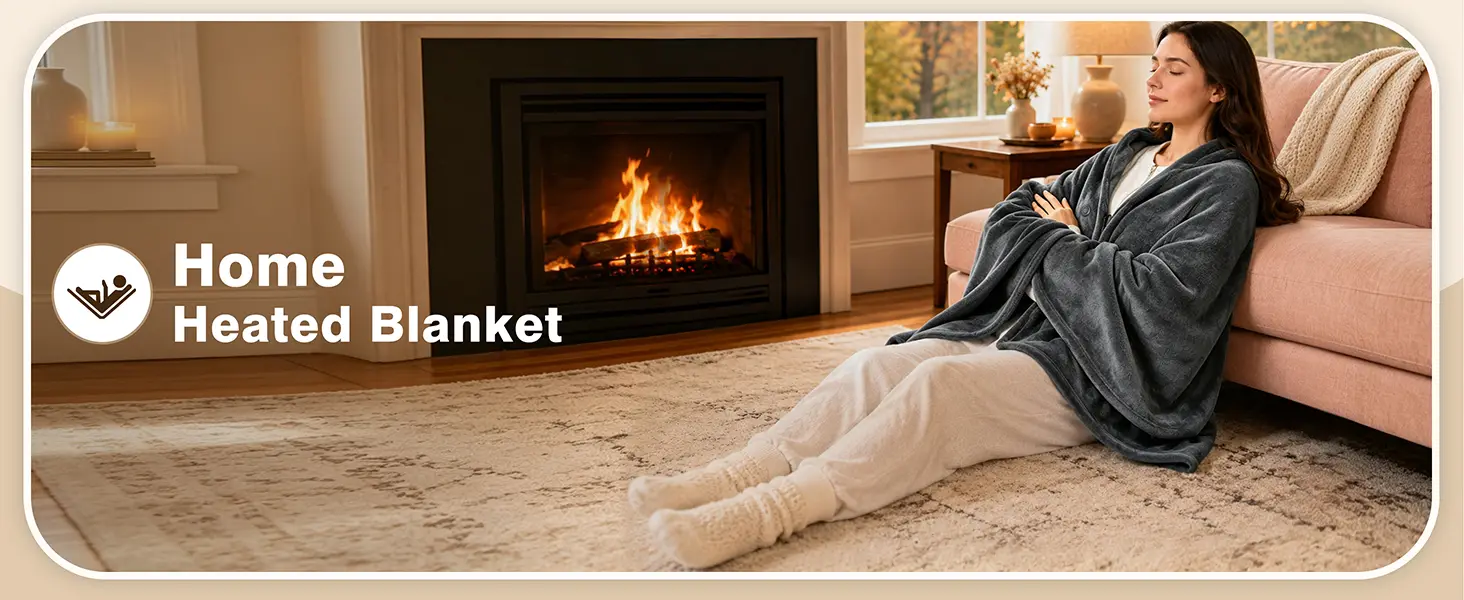
Broad coverage works well when the user remains seated for long periods.
The heater stays positioned on the torso while the user moves.
Useful for bleachers and other long-duration stationary situations.
More practical than carrying or continuously repositioning a blanket.
Localized lap or shoulder heat can improve comfort without heating the complete room.
Sitting favors a blanket. Walking and standing outdoors favor a vest.
Camping is a good example where both formats can make sense at different times.
A vest is useful while setting up camp. A blanket becomes more useful once the user sits down for the evening.
7. Passive Insulation Still Matters
The heating element creates heat. The textile determines how efficiently that heat remains around the user.
Heating elements, controls, wiring, connectors and battery provide active thermal energy.
Fabric, fleece, insulation, wind resistance and fit determine how quickly that heat is lost.
A poorly insulated product can consume more battery energy while still feeling less comfortable.
A good heated product does not only make heat. It keeps that heat where the user needs it.
Safety Is Part of Product Performance
Heated textiles combine flexible fabric with wiring, electrical heating elements, connectors and rechargeable batteries.
That makes the durability and protection system just as important as the advertised temperature.
Key Areas to Evaluate
Temperature Protection Controls should prevent abnormal overheating.
Short-Circuit Protection The battery and control system should include appropriate protection.
Wire Routing Heating wires should withstand normal folding and movement.
Connector Durability Repeated plugging, unplugging and washing should not damage the connection.
Battery Condition Swelling, damage or abnormal heating should be treated seriously.
Heat Uniformity Unexpected concentrated hot areas can indicate a problem.
A 2026 U.S. consumer-safety warning involving an electric heated blanket showed why internal heating-wire design matters: overheated elements could melt through the textile and create burn and fire hazards.
Machine Washable Does Not Mean the Electrical System Can Be Ignored
Cordless heated blankets can be designed for machine washing, but removable batteries should be disconnected before washing and the electrical connector should be handled according to the care instructions.
For product development, the more useful question is not simply:
Can the product be washed?
It is:
How does the heating system perform after repeated wash cycles?
A proper durability program can evaluate heater position, wire continuity, fabric shrinkage, connector reliability and electrical performance after repeated washing.
Can Battery-Powered Heated Gear Travel by Air?
Lithium-battery rules are based primarily on watt-hours rather than mAh.
General U.S. Passenger Battery Limits
0–100 Wh
101–160 Wh
Over 160 Wh
Generally permitted within applicable passenger rules.
Airline approval is normally required.
Generally prohibited for normal passenger carriage.
Spare lithium batteries and power banks must be carried in carry-on baggage rather than checked baggage under U.S. passenger rules.
Heat-producing battery devices also need protection against accidental activation, and airline-specific requirements should always be checked before travel.
For travel products, print the battery's Wh rating clearly. It is more useful than mAh alone.
What Retail Buyers Should Specify Before Sourcing Heated Gear
Define zone count, actual zone dimensions, heater material, placement, temperature levels and warm-up time.
Define chemistry, voltage, Wh rating, connector type, protection system and charging specifications.
Define fabric composition, insulation, weight, softness, wind resistance and abrasion requirements.
Review wiring routes, battery-pocket position, controller position, bending durability and connector protection.
Verify temperature distribution, runtime, wash durability, electrical protection and battery documentation.
Include battery markings, warnings, operating instructions, care instructions and transport information.
Do not source heated products primarily from price + mAh + heating-zone count.
Heated Blanket vs Heated Vest: Final Comparison
| Factor | Cordless Heated Blanket | Heated Vest |
|---|---|---|
| Broad Coverage | Excellent | Moderate |
| Mobility | Moderate | Excellent |
| Seated Use | Excellent | Good |
| Outdoor Work | Limited | Excellent |
| Camping Chair | Excellent | Good |
| Walking / Commuting | Moderate | Excellent |
| Fit Requirement | Low | High |
| Size Complexity | Low | Higher |
| Shared Use | Easy | Limited by size |
| Heating Position | Flexible | Fixed to body |
Final Verdict: Which One Should You Choose?
A cordless heated blanket and heated vest solve two different cold-weather problems.
Choose a heated blanket when the priority is broad coverage, comfort and stationary use.
Choose a heated vest when the priority is mobility, core heating and consistent heater placement.
But the most important lesson applies to both categories.
Do not compare heated products only by temperature, number of zones or battery mAh.
A useful evaluation considers heated area, insulation, actual power consumption, battery Wh, runtime conditions, safety, wash durability and intended use.
That is what separates an impressive specification sheet from a product that actually works through a winter season.
Developing a Battery-Powered Heated Product?
For heated blankets, heated vests and other battery-powered textiles, supplier selection should consider textile construction, heater layout, battery specifications, safety documentation, testing, packaging and quality control as one integrated project.
Discuss Your Heated Product ProjectTechnical & Safety References
- Reference cordless heated blanket specification page supplied for this article.
- U.S. Consumer Product Safety Commission — 2026 electric heated blanket safety warning concerning overheating heating elements.
- Federal Aviation Administration — Airline Passengers and Batteries guidance.
- Federal Aviation Administration — Battery-Powered Heat-Producing Devices guidance.
- Recent 2026 consumer and outdoor-industry coverage of portable heated blankets and heated vests.