


Candle Jar Sizes and Capacities: Buyer Guide | HUIN
Understand candle jar capacity, usable wax fill, dimensions, weight and packing efficiency before choosing sizes for a retail candle range.
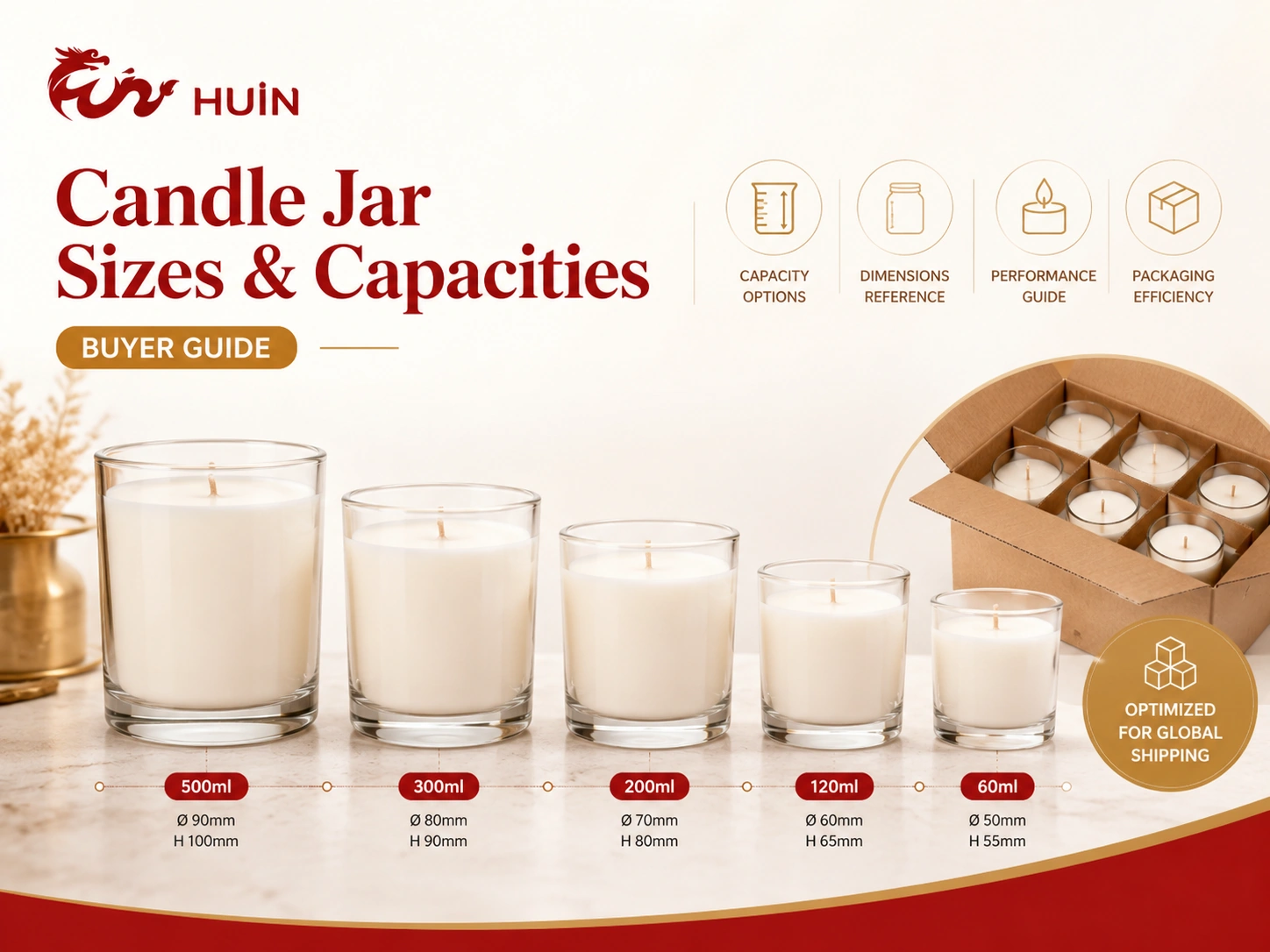
Candle Jar Sizes and Capacities: A Buyer’s Guide
How to compare candle jar capacity, usable wax fill, internal dimensions, finished weight and packing efficiency before approving a retail candle range.

Quick Answer
Define candle jar size using verified dimensions and usable wax fill, not a single ounce label. Buyers should distinguish brimful capacity, approved fill line, net wax weight, empty-jar weight and finished-unit weight before comparing products, packaging efficiency or freight costs.
Key Takeaways
- Ask for verified dimensions and milliliter capacity in addition to any ounce description.
- Confirm the actual production fill using the intended wax and fragrance formula and approved headspace.
- Use the vessel’s internal diameter and depth to support candle development.
- Build a coordinated candle jar size family instead of choosing unrelated vessels.
- Compare carton quantity, gross weight, pallet pattern and finished parcel size before final approval.
1. Understand the Different Meanings of “Capacity”
The word “capacity” can describe several different measurements in the candle jar market. Buyers should record each figure separately because these values are not interchangeable.
Four Measurements Buyers Should Distinguish
Brimful capacity: The volume of liquid the vessel holds when filled to the top rim.
Recommended fill volume: The usable volume below the rim after allowing for the intended headspace.
Net wax weight: The mass of the selected wax and fragrance formula at the approved fill line.
Finished-unit weight: The total assembled weight of the jar, wax, wick, lid, label and other components.
Two products sold as “8 oz candle jars” may have different internal diameters, actual wax fills, empty weights and carton efficiencies.
For accurate costing and product comparison, record every measurement separately.
2. Use a Complete Candle Jar Dimensional Specification
Outer diameter and height describe shelf footprint and retail box size, but the internal measurements are equally important.
Important Dimensions Include:
- Outer diameter
- Overall height
- Internal diameter near the wax surface
- Internal depth
- Wall taper
- Bottom geometry
- Rim and lid-contact dimensions
- Usable label area
Buyer Focus: The internal diameter near the wax surface provides an important starting point for wick development. Internal depth, taper and bottom geometry influence usable fill and remaining wax.
A controlled manufacturing drawing should identify the dimensions and tolerances that matter to the project so manufacturing and inspection teams follow the same standard.
3. Confirm the Production Fill With a Physical Sample
Wax density changes by formula, and fragrance, dye or other additives may influence the final mass.
Buyers should fill a representative candle jar sample using the intended formula, allow for the required production headspace and record the approved reference.
A Physical Fill Test Should Record:
- Approved fill line
- Distance from the fill line to the rim
- Net wax weight
- Finished-unit weight
Do not calculate a retail wax claim only from a water-capacity figure.
A physical fill check gives purchasing, production, labeling and packaging teams one agreed reference.
4. Build a Deliberate Candle Jar Size Architecture
A well-planned retail range gives each candle jar size a clear commercial role.
| Jar Size | Typical Application | Commercial Role |
|---|---|---|
| Small | Discovery sets, gifting and travel formats | Supports trial purchases, gifting and new-fragrance testing |
| Core | Main fragrance collection | Acts as the principal retail size for repeat production |
| Large | Premium ranges and statement products | Creates stronger shelf impact and perceived value |
Where possible, different sizes should share a coordinated visual language through related shapes, finishes and lids.
Compatible rim dimensions or common packaging components may simplify purchasing, but every lid and box combination should still be physically verified.
5. Include Packing Density in the Candle Jar Size Decision
A vessel that holds slightly more wax may require a significantly larger carton or heavier protective packaging.
Compare These Factors Before Approval:
- Units per master carton
- Master carton dimensions
- Gross carton weight
- Pallet pattern
- Likely e-commerce parcel size
- Weight of protective packaging
Key Conclusion: The lowest candle jar unit price does not always create the lowest landed cost. A lighter or more efficiently packed vessel may improve freight economics without reducing the perceived value of the finished candle.
Candle Jar Measurement Sheet
Use this measurement sheet to keep purchasing, product development, manufacturing and packaging teams aligned.
| Specification | Record | Why It Matters |
|---|---|---|
| Brimful capacity | Milliliters to the top rim | Provides a consistent volume reference, not the retail wax claim |
| Approved fill line | Distance below the rim | Controls headspace, appearance and filling consistency |
| Net wax weight | Final formula at the approved fill line | Supports labeling, costing and production planning |
| Internal diameter | Measured at the wax surface | Provides a starting point for wick development |
| Empty / finished weight | Jar only and fully assembled | Affects handling, parcel cost and shelf feel |
| Carton configuration | Units, dimensions and gross weight | Shows packing efficiency and export impact |
How HUIN Controls Candle Jar Size and Capacity
As a candle jar manufacturer, HUIN verifies vessel dimensions, capacity data, sample codes and approved fill references before bulk production.
Key dimensions are placed on controlled manufacturing drawings so manufacturing and inspection teams use the same standard.
HUIN also checks the following information with the selected candle jar size:
- Lid fit and rim compatibility
- Units per carton
- Carton dimensions and gross weight
- Protective packaging requirements
- Pallet utilization and transportation impact
This allows buyers to evaluate product presentation, production fill and transportation impact before the size range is finalized.
Frequently Asked Questions
Is an 8 oz jar the same as an 8 oz candle?
Not necessarily. One description may refer to liquid volume, while the other refers to wax mass. Confirm the actual wax fill using the final formula and approved headspace.
Which candle jar dimension matters most for wick development?
Internal diameter at the wax surface is an important starting point, but the complete vessel geometry, wax, fragrance and wick construction must also be considered.
How much headspace should a candle have?
There is no universal figure. Establish the headspace during product development according to the vessel, filling process, appearance and final product requirements.
Why do similar-size candle jars have different freight costs?
Empty weight, outer dimensions, units per carton, protective packaging and pallet utilization may all be different.
Can one lid fit several candle jar sizes?
Yes, when rim dimensions are intentionally designed as a coordinated family. Production samples and tolerance ranges should still be physically checked.
Related Reading
Confirm the Size Before You Confirm the Price
Before comparing candle jar prices, confirm the target wax fill, preferred outer dimensions, lid requirements, order quantity, packaging format and destination market.
Only after these factors are defined can buyers accurately compare jar sizes, production fill, packing efficiency and total landed cost.