


Questions to Ask a Candle Jar Manufacturer Before Ordering | HUIN
Buyer checklist for selecting HUIN candle jar manufacturer with factory production, quality control, and customization capability
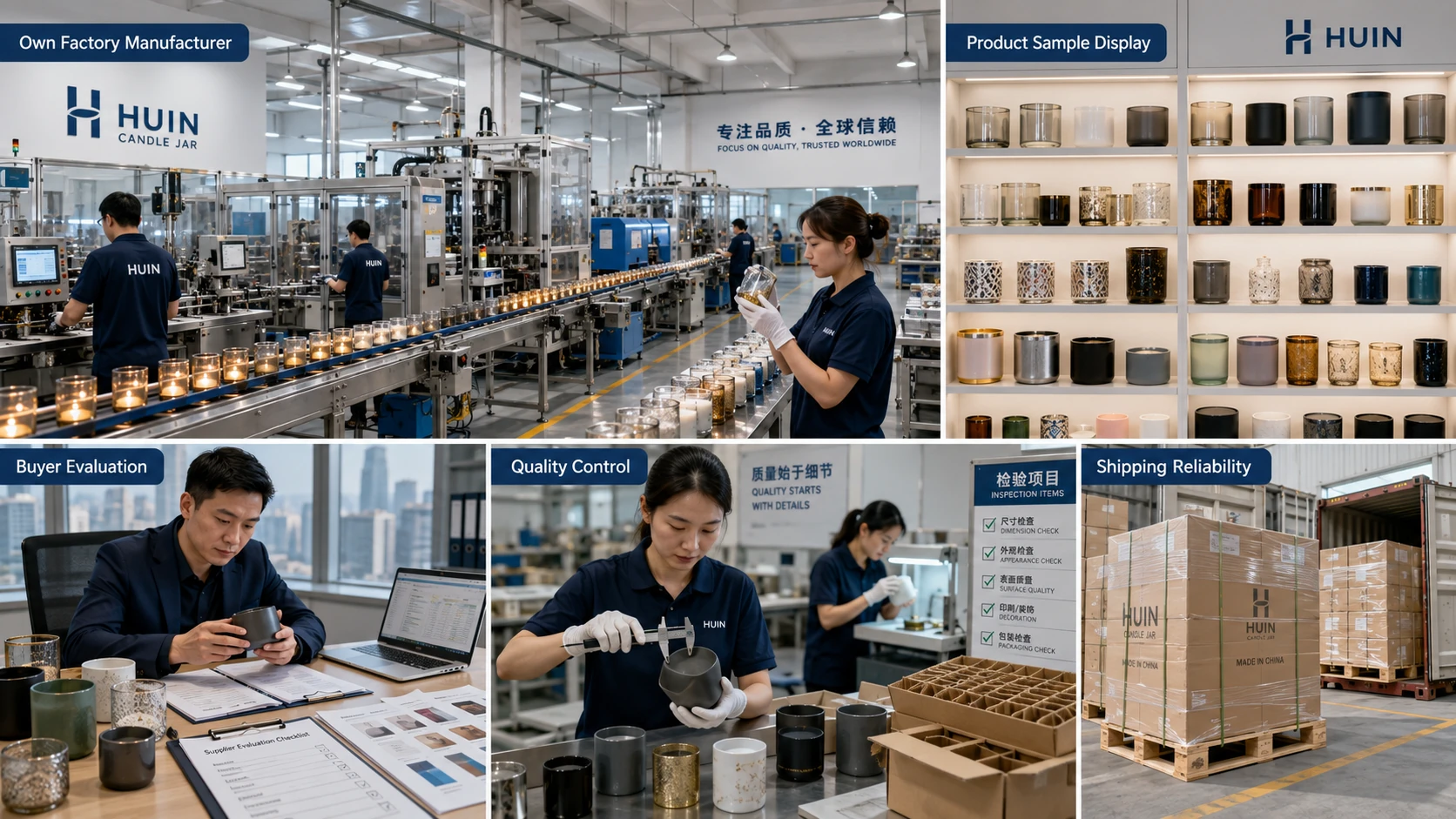
What Do Buyers Ask Before Choosing a Candle Jar Manufacturer?
The key questions procurement teams use to evaluate production stability, capacity, packaging, customization, quality control, delivery, and long-term manufacturing capability.
Quick Answer
Experienced buyers ask how a candle jar manufacturer performs under real production conditions rather than evaluating the sample alone. They review repeatability, peak-season capacity, shipping protection, customization depth, preventive quality control, delivery systems, issue responsibility, and long-term scalability.
In global candle jar sourcing, experienced buyers do not evaluate price in isolation.
Price becomes meaningful only when it is evaluated together with quality, delivery reliability, packaging protection, communication efficiency, and long-term supply performance.
What professional buyers actually evaluate is risk, repeatability, and long-term manufacturing control—not only a single quotation.
At HUIN, we observe a consistent pattern: the quality of a supplier relationship depends on more than the sample. It also depends on the controls used during mass production and repeat orders.
HUIN is a candle jar manufacturer with its own factory, supporting global brands through OEM/ODM customization, production control, quality management, packaging solutions, and scalable manufacturing capabilities.
By combining manufacturing experience with structured production systems, HUIN helps brands reduce sourcing risks and build more reliable candle jar supply solutions.
1. Can You Maintain Stability When Production Scales?
Many suppliers can produce an acceptable sample. But experienced buyers do not evaluate samples alone; they also evaluate mass-production repeatability.
Buyers Usually Ask:
- Can the same quality be maintained as an order moves from trial production to larger repeat volumes?
- How do you control variation between batches?
- What happens when molds start to wear out?
In real manufacturing, some forms of instability may become visible only after production volume increases.
That is why professional buyers prioritize not only sample quality, but production repeatability under different order conditions.
HUIN Manufacturing Approach
HUIN supports production stability through documented mold-maintenance planning, batch-level quality checks, and procedures for identifying and isolating nonconforming products.
2. What Is Your Stable Capacity During Peak Season?
Suppliers often answer this question with a single output number. Experienced buyers know that a single capacity number has limited value without production context.
Buyers Want to Understand:
- What is stable output in normal season versus peak season?
- How many production lines can operate simultaneously?
- What happens when demand increases unexpectedly?
In global sourcing, capacity evaluation is not limited to maximum output.
Buyers also consider whether stable output, quality control, and delivery planning can be maintained when demand changes.
Suppliers with production planning and capacity arrangements are better prepared to support repeat orders and seasonal demand fluctuations.
3. How Do You Control Breakage in International Shipping Conditions?
Glass candle jars can face risks in both production and logistics, but shipping often introduces additional stresses that are not visible during factory inspection.
Professional Buyers Evaluate:
- Drop resistance of packaging structure
- Vibration behavior during ocean freight
- Compression resistance during container stacking
- Historical breakage feedback from export shipments
For fragile glass products, packaging should be considered as part of product and logistics planning rather than only a final production step.
At HUIN, packaging systems are considered together with product structure and transportation conditions to help reduce avoidable risks during international delivery.
Learn more about candle jar packaging and shipping protection solutions for international logistics conditions.
4. Can You Support Brand-Level Customization?
Basic suppliers can change colors or add logos. But brand-level buyers ask deeper questions about whether the manufacturer can transform design concepts into stable production solutions.
Buyers Usually Ask:
- Can you develop exclusive molds?
- Can surface finishes be engineered and reproduced consistently?
- Can Pantone colors and decorative effects remain stable between batches?
- Can the original design concept be transferred into mass production?
Advanced customization requires more than changing appearance. It involves product structure, mold engineering, surface treatment, specifications, and repeat production control.
At HUIN, customization is managed as a controlled development process from product evaluation and mold engineering to surface treatment validation and production preparation.
Learn more about the custom candle jar development process from concept evaluation to production preparation.

5. How Is Quality Controlled Beyond Final Inspection?
Some manufacturers rely heavily on final inspection. However, experienced buyers understand that final inspection can identify visible problems, but preventive controls are also needed earlier in the process.
Buyers Evaluate:
- Incoming material control and consistency
- In-process quality checkpoints
- Defect classification systems
- Export-grade quality requirements
Effective quality control combines inspection with preventive controls across production stages.
HUIN integrates quality management into material evaluation, production monitoring, product inspection, packaging confirmation, and shipment preparation.
Buyers can also review more factors involved in candle jar supplier evaluation criteria beyond unit price.

6. How Do You Support Delivery Stability Across Supply Cycles?
Lead-time reliability depends on system capability, not only on a promised delivery date.
Buyers Evaluate:
- Whether production schedules can be adjusted according to demand changes
- How container booking and shipment planning are managed during peak seasons
- Whether delays affect multiple production batches
- Historical consistency of on-time delivery performance
In global sourcing, late delivery is not only a scheduling issue. It can also affect product launches, inventory availability, retail commitments, and market opportunities.
Professional buyers evaluate whether a manufacturer has production planning and supply coordination systems that support stable delivery across normal and peak periods.
7. What Happens After Shipment If Something Goes Wrong?
Professional buyers recognize that problems can occur during international supply chains. They evaluate supplier maturity by understanding how issues are handled after shipment.
Buyers Evaluate:
- Who reviews shipment issues and analyzes the cause
- How affected batches are identified
- What replacement or corrective actions are available
- How quickly export issues receive a response
A mature manufacturing partner defines issue-handling procedures before shipment and responds through clear communication, evidence review, and corrective action.
Long-term supplier relationships depend not only on preventing problems, but also on managing challenges responsibly when they occur.
8. Can You Scale With the Brand Over Time?
Serious buyers are not selecting a supplier for only one order. They may also be selecting a manufacturing partner that can support future products and repeat business.
Long-Term Evaluation Factors:
- Can the manufacturer support increasing order volumes?
- Can new designs be developed continuously?
- Can consistent quality be maintained across different markets?
- Can the supplier support long-term cooperation?
Switching suppliers after business growth can create additional costs and risks. Therefore, experienced buyers prefer manufacturing systems that can evolve together with their brands.
Learn more about how brands choose a reliable candle jar supplier for long-term cooperation.