


Are Glass Candle Jars Heat Resistant? Buyer Guide | HUIN
Learn how glass quality, geometry, annealing, defect control and finished-candle testing affect candle jar heat performance before bulk production.
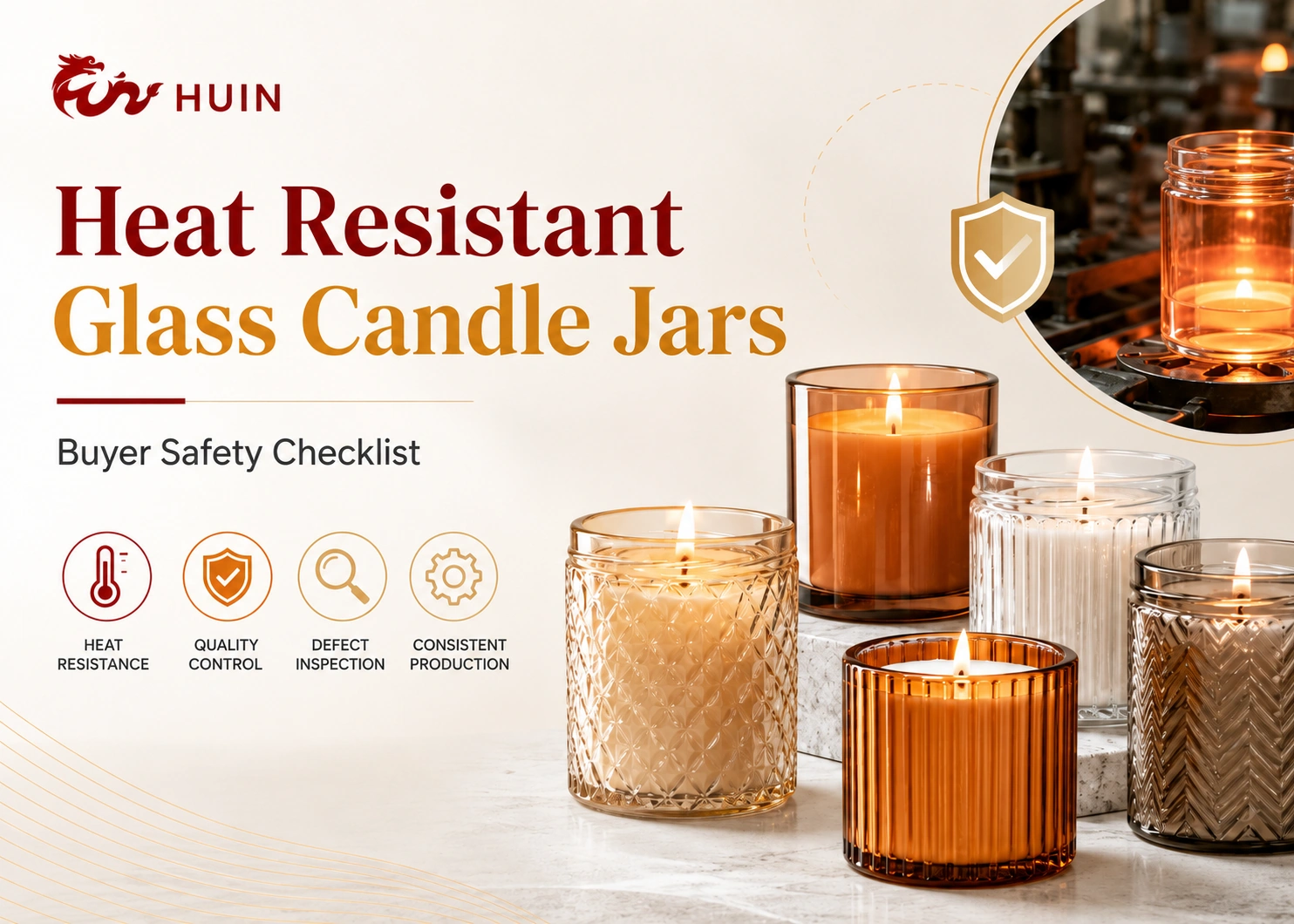
Are Glass Candle Jars Heat Resistant? A Buyer Safety Checklist
How glass quality, vessel geometry, annealing, defect control and finished-candle testing influence candle jar heat performance.

Quick Answer
A glass jar is not suitable for candle use simply because it is thick. Candle jar heat performance depends on glass quality, vessel geometry, wall distribution, manufacturing consistency, annealing control and defect management. The complete candle must also be evaluated using the final wax, fragrance, wick, fill weight and intended use conditions.
Key Takeaways
- Do not judge candle jar heat resistance from wall thickness alone.
- Control the glass specification, vessel geometry, annealing process and defect criteria.
- Test the finished candle system, not only an empty glass vessel.
- Use representative samples from the intended manufacturing route.
- Repeat the review after meaningful changes to the jar, wax, fragrance, wick or fill level.
1. Heat Performance Is Created by the Whole Candle
A burning candle does not heat the glass vessel evenly.
Temperature distribution can be influenced by:
- Flame size
- Wick position
- Wax level
- Melt-pool development
- Airflow around the candle
- Duration of each burn cycle
These conditions can create localized temperature differences that interact with the vessel’s shape, wall transitions and base geometry.
Buyer Focus: A general statement that a jar is “heat resistant” is not enough. Buyers need both manufacturing information for the glass vessel and validation data for the finished candle.
2. Glass Design and Manufacturing Consistency Matter
Candle jar heat performance can be influenced by the complete glass manufacturing specification.
Important Manufacturing Factors Include:
- Glass composition
- Wall thickness distribution
- Rim formation
- Base transitions
- Mold condition
- Dimensional consistency
- Annealing control
A controlled manufacturing process aims to keep these characteristics within the approved specification from one production batch to the next.
Why Annealing Matters
Formed glass can retain internal stress. Annealing is used to reduce internal stress under controlled conditions, helping the finished vessel maintain more consistent performance.
Buyers should confirm that the candle jar manufacturer has a defined production and quality-control process for the intended vessel program rather than relying on appearance alone.
3. Separate Cosmetic Variation From Functional Defects
Glass manufacturing may create minor visual variation, but cosmetic variation and functional defects should not be treated as the same issue.
| Quality Area | Examples | Buyer Requirement |
|---|---|---|
| Cosmetic variation | Minor visual differences within the approved range | Use measurable standards, photos and approved physical references |
| Functional defects | Cracks, sharp edges, unstable bases and severe distortion | Define clear rejection and corrective-action criteria |
Vague requirements such as “perfect quality” can create disagreement without improving inspection control.
A defect catalogue, approved quality limit, reference photographs and golden samples make inspection and corrective action more consistent.
4. Test the Finished Candle Through Its Intended Life
Testing an empty glass jar alone is not enough to validate the finished candle.
The validation program should use the final:
- Glass candle jar
- Wax formula
- Fragrance load
- Dye, when applicable
- Wick and wick tab
- Adhesive
- Approved fill weight
- Intended user instructions
Finished-Candle Testing Should Observe:
- Flame behavior
- Wick position
- Soot development
- Glass vessel condition
- Temperature distribution
- End-of-life performance
The candle brand or its qualified testing partner should determine the test method and acceptance criteria required for the destination market.
Manufacturing and Testing Responsibilities
The candle jar manufacturer supports: vessel drawings, dimensional consistency, production control, defect inspection and representative samples.
The candle brand and its qualified testing partner remain responsible for: the complete candle formula, wick selection, finished-product validation and market-specific safety approval.
5. Apply Change Control to Repeat Orders
A repeat order should reproduce the approved specification rather than rely on memory or a generic catalogue description.
A documented review may be required after changes to:
- Mold condition or mold source
- Wall distribution
- Glass source
- Vessel dimensions
- Surface finish
- Wax formula
- Fragrance load
- Wick specification
- Approved fill line
Important: The project record should identify which changes require review, new samples or repeat testing.
Buyer Safety Review
| Control Point | Buyer Should Verify | Responsible Evidence |
|---|---|---|
| Vessel specification | Dimensions, geometry and intended use | Approved drawing and sample code |
| Manufacturing consistency | Defined process and batch identification | Manufacturer production and QC records |
| Defect control | Functional and cosmetic acceptance criteria | Defect photos, golden sample and inspection checklist |
| Finished-candle validation | Final jar, formula, wick and fill level | Brand or qualified laboratory test records |
| Repeat-order change control | Review of material or specification changes | Written change approval and retest decision |
How HUIN Manages Glass Candle Jar Quality
HUIN is a candle jar manufacturer that manages approved vessel drawings, physical standards, visible-defect criteria, production identification and export packaging for each glass candle jar program.
Inspection is performed against the agreed specification rather than a generic statement of quality.
HUIN supplies representative glass candle jars and maintains manufacturing consistency for approved repeat orders.
Final candle formulation, wick selection and market-specific safety approval remain the responsibility of the candle brand and its qualified testing partners.
Frequently Asked Questions
Does thicker glass always mean better heat resistance?
No. Glass composition, vessel geometry, wall distribution, annealing, defects and localized temperature differences all influence heat performance.
Can drinking glasses be used as candle jars?
Do not assume so. The intended use, manufacturing specification and complete candle performance should be evaluated before product development.
Is testing an empty glass jar enough?
No. The finished candle should also be evaluated because the wax, fragrance, wick, fill level and use conditions change the heat profile.
Can a manufacturer guarantee that a candle jar will never break?
A responsible manufacturer should not make an absolute guarantee. Risk is managed through design control, manufacturing consistency, inspection, finished-candle testing and correct use.
When should a candle be retested?
Review testing after meaningful changes to the jar, formula, fragrance load, wick, fill level, manufacturing specification or intended use.
Related Reading
Review the Complete Candle System Before Bulk Production
Glass candle jar heat performance should be evaluated through controlled vessel manufacturing, documented defect inspection and finished-candle testing.
Buyers should document the approved vessel specification and review meaningful changes before repeat production.