

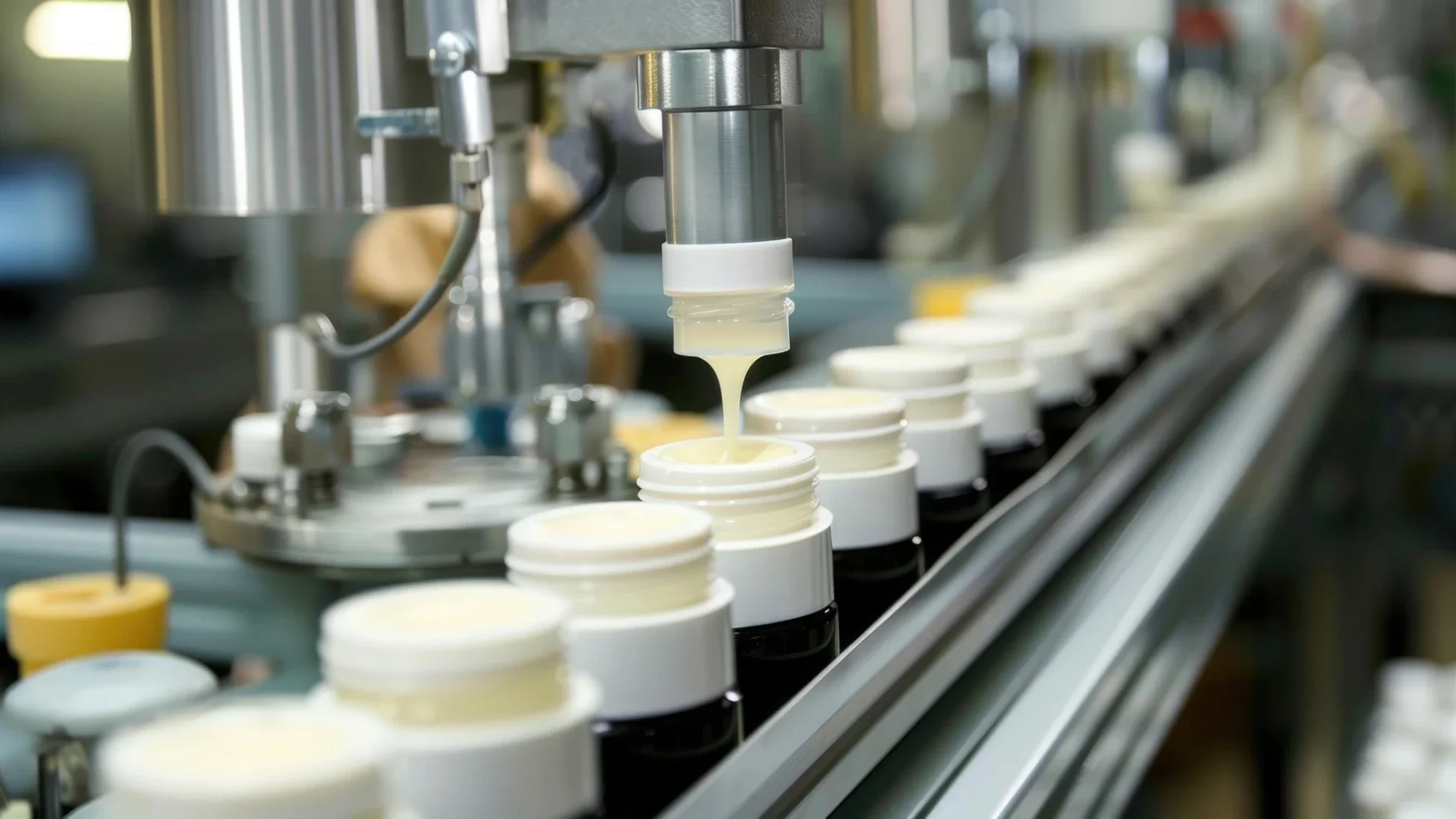
Viscosity, heating, homogenization and packaging requirements should determine equipment selection.
Factory & Manufacturing Insights
Cosmetic Production Lines in 2026: 7 Bottlenecks to Fix
2026-09-10By HUIN Team
Learn 7 hidden bottlenecks in cosmetic production lines—from mixing and cleaning to filling, packaging, traceability and ROI—before investing in automation.
2026 Cosmetic Manufacturing Guide
Automation Does Not Fix a Badly Designed Production Process
The most productive cosmetic factory is not necessarily the one with the fastest filling machine. Mixing, cooling, cleaning, changeover, packaging, traceability and utilities can all become the real production bottleneck.
Executive Summary
Cosmetic manufacturing is moving toward more SKUs, shorter production runs and greater flexibility. That changes how production lines should be designed and evaluated.
Tank size alone says very little about real production capacity.
Cleaning and SKU change time can consume a major part of a high-mix production shift.
The useful metric is acceptable finished units per shift—not theoretical machine speed.

A Faster Machine Does Not Automatically Create a Faster Production Line
Beauty manufacturers are managing more SKUs, fragrances, package sizes, private-label projects and formulation variations than traditional single-product factories.
This creates a different manufacturing problem.
A factory may need to produce shampoo in the morning, body lotion in the afternoon and a different fragrance or package format the following day.
Low-volume, high-mix manufacturing therefore puts increasing value on flexibility, shorter changeovers, inventory control and process consistency.
The Better Buying Question How many saleable finished products can the complete factory reliably produce per shift?
That question is more useful than asking only how many bottles one machine can fill per minute.
Choosing Equipment Before Defining the Product Family
There is no universal cosmetic production line because different formulations behave very differently during manufacturing and filling.
| Product | Typical Manufacturing Challenge |
|---|---|
| Toner | Low viscosity and accurate high-speed liquid filling. |
| Shampoo | Foaming during mixing, transfer and filling. |
| Serum | Small fill volumes and formulation sensitivity. |
| Cream / Lotion | Heating, emulsification, homogenization, cooling and higher viscosity. |
Before selecting equipment, manufacturers should create a product-family matrix covering:
- Viscosity range
- Batch volume
- Heating requirements
- Cooling requirements
- Homogenization requirements
- Vacuum requirements
- Foaming tendency
- Fill volume
- Container type
- Cap or pump format
- Label format
- Cleaning difficulty
Do not design the factory around the first product. Design it around the range of products the factory expects to manufacture.
Looking at Mixing-Tank Capacity Instead of Complete Batch Time
A 1,000-liter vessel does not mean a factory can manufacture 1,000 liters every hour.
For an emulsified product, one complete cycle may include raw-material charging, heating, mixing, homogenization, vacuum deaeration, cooling, quality sampling, transfer and cleaning.
Example: 1,000 L ÷ 4 hours = 250 L/hour
A vessel with a nominal 1,000-liter capacity can still become a 250-liter-per-hour process if the complete batch cycle requires four hours.
Now imagine the filling machine can theoretically process 40 bottles per minute at 200 ml per bottle.
40 × 0.2 L × 60 minutes = 480 L/hour
The filler can theoretically consume product almost twice as fast as the processing area can supply it.
Buying a faster filler will not solve an upstream manufacturing bottleneck.
Cooling time is particularly important for emulsified creams and lotions. A powerful homogenizer may complete dispersion quickly, but the product still cannot proceed to filling until the required temperature and physical condition are reached.
Underestimating Cleaning and Product Changeover
Cleaning becomes a production-capacity issue when one factory needs to manufacture many formulations, fragrances and colors.
Changing from a fragranced body lotion to an unscented sensitive-skin formula may require much more than simply emptying the tank.
Operators may need to clean:
- Processing vessels
- Homogenizers
- Transfer piping
- Pumps
- Product-contact valves
- Filling systems
Residual fragrance, pigment or formulation material can contaminate the next production batch.
40%
Changeover can consume a major part of the available operating window.
In a simplified example, three hours of manufacturing plus two hours of cleaning and product changeover means two out of five operating hours are not producing saleable units.
Evaluate Cleanability Before Buying
Can bulk product completely drain from vessels and transfer systems?
Are there locations where formulation or cleaning liquid can remain trapped?
Can operators reach critical product-contact areas efficiently?
Can cleaning-in-place be integrated where it is justified by the process?
In a high-mix factory, reducing changeover time can create more useful capacity than increasing theoretical filling speed.

Assuming One Filling Technology Can Handle Every Cosmetic
Cosmetic formulas can range from almost water-like liquids to thick creams, gels and masks.
Toners, micellar water and some serums require accurate control of fast-flowing liquids.
Shampoos and body washes may require controlled filling to reduce foam and bottle-neck contamination.
Creams, masks and thick lotions require appropriate product-transfer and dosing technology.
Serums, eye products and concentrated formulas may demand tighter low-volume dosing control.
Depending on the formulation, manufacturers may evaluate piston, servo-controlled, pump, flow-based, bottom-up or anti-drip filling approaches.
Foaming deserves particular attention. A machine may theoretically be capable of filling 50 bottles per minute, but if the speed must be reduced because foam rises inside the bottle and contaminates the neck, the advertised speed has little practical value.
The useful filling speed is the fastest speed that still produces an accurate, clean and saleable finished package.
The Filling Machine Is Fast—but the Capper Is Slow
A production line runs at the speed of its slowest critical process.
Consider a simplified skincare packaging line.
Where Is the Real Bottleneck?
Filling 60/min
Capping 35/min
Labeling 50/min
Cartoning 40/min
Although the filler is rated at 60 bottles per minute, the line cannot continuously exceed approximately 35 bottles per minute when capping is the slowest critical station.
Cosmetic packaging can make line balancing difficult because manufacturers may need to process:
- Screw caps
- Pumps
- Droppers
- Spray heads
- Flip-top caps
- Jar lids
- Inner plugs
- Decorative outer covers
Automatic equipment may need to separate, orient, position and tighten these components before the next production stage can proceed.
Test With the Real Packaging
Before final equipment approval, send the equipment supplier the real bottles, jars, caps, pumps, droppers and labels that will actually run on the line.
A generic demonstration bottle cannot reveal every production problem the customer's real packaging will create.
Treating Traceability as Office Paperwork Instead of Production-Line Design
Modern cosmetic manufacturing increasingly requires structured records that connect raw materials, processing, filling and packaging with the finished product.
Useful production records may include:
- Raw-material lot numbers
- Quantities weighed
- Batch formulation
- Production date
- Operator identification
- Processing parameters
- Equipment identification
- Quality-control results
- Filling records
- Packaging-material lots
- Finished-product batch codes
For cosmetics sold in the United States, regulatory obligations under MoCRA have made facility registration, product listing, safety substantiation and record management increasingly important parts of cosmetic manufacturing operations.
Facility registration should not be confused with FDA approval of a cosmetic product or with a general FDA compliance certificate.
When comparing production lines, ask not only what the equipment can automate—but what production data the manufacturing system can reliably record and trace.
Buying Automation Before Checking Factory Utilities
Production machinery does not operate independently from the facility around it.
Depending on the process, a cosmetic factory may need sufficient:
- Electrical capacity
- Compressed air
- Purified water
- Hot water or steam
- Chilled water
- Ventilation
- Drainage
- HVAC capacity
- Wastewater handling
Confirm installed power, voltage, peak demand and electrical distribution capacity.
Automatic valves, cylinders and packaging systems may depend on stable air pressure.
Steam, hot water, chillers or cooling water can determine real batch-cycle time.
Purified water, cleaning water and wastewater handling should be planned together with equipment.
A high-capacity emulsification vessel can still have poor output if the installed chiller cannot cool the product quickly enough.
Likewise, an automatic packaging line may repeatedly stop when compressed-air pressure is unstable.
The production line should be designed together with the factory infrastructure—not delivered first and accommodated later.
Fully Automatic vs Semi-Automatic vs Flexible Automation
Higher automation is not automatically the better investment.
The correct level depends on production volume, SKU variety, packaging complexity, labor structure and expected changeover frequency.
Lower initial investment and greater manual flexibility for pilot production, startups and smaller production volumes.
Designed for manufacturers balancing SKU variety, repeated formats, automation and faster product changeovers.
Best suited to high-volume manufacturing where product and packaging formats change less frequently.
| Manufacturing Situation | Typical Approach |
|---|---|
| Startup / Pilot Production | Semi-automatic or modular equipment |
| Many SKUs, Smaller Batches | Flexible modular automation |
| Medium Volume, Repeated Formats | Hybrid automatic line |
| Large Volume, Few SKUs | Highly automatic dedicated line |
| OEM / Contract Manufacturer | Fast-changeover flexible equipment |
A factory producing millions of identical bottles may achieve excellent economics from a dedicated high-speed line.
A contract manufacturer handling dozens of formulas and packaging formats may obtain more value from flexible machines that change between products quickly.
Maximum bottles per minute is not the most useful automation metric. Saleable units per shift is.
A Better Way to Calculate Cosmetic Production-Line ROI
A simplistic automation calculation looks only at equipment cost and labor savings.
A better model considers the entire operating system.
Potential Benefits
- Reduced direct labor
- Higher useful output
- Lower product loss
- Improved filling consistency
- Reduced rework
- Faster changeovers
- Lower packaging defect rates
Operating Costs
- Equipment depreciation
- Maintenance
- Utilities
- Spare parts
- Cleaning
- Technical training
- Planned and unplanned downtime
Real Manufacturing Cost Per Saleable Unit
Labor + Utilities + Cleaning + Changeover + Product Loss + Rejects + Maintenance + Equipment Cost
÷
Saleable Finished Units
The final word matters.
A line may produce 30,000 units, but those numbers lose meaning if products leak, filling accuracy is unacceptable or labels and caps do not meet the customer's finished-goods standard.
The customer does not pay for theoretical machine output. The customer pays for acceptable finished products.
10 Questions to Ask Before Buying a Cosmetic Production Line
Before requesting a final equipment configuration, manufacturers should be able to answer these questions.
If these questions cannot yet be answered, choosing machinery primarily on advertised speed is premature.
What Is Changing in Cosmetic Manufacturing in 2026?
Beauty manufacturers increasingly need shorter production runs, larger SKU ranges and more flexible production planning.
Process monitoring, automation and connected manufacturing systems increasingly support better production control and scalability.
Manufacturing records and product traceability are becoming increasingly important parts of quality and regulatory management.
Flexible production can help reduce the need to hold excessive finished-product inventory when market demand changes quickly.
The cosmetic production line of the future is not simply faster. It is more flexible, more traceable and easier to control.

Final Verdict: What Makes a Good Cosmetic Production Line in 2026?
A production line should be evaluated as a complete manufacturing system rather than a collection of individual machines.
Processing Mixing & Cooling Filling Packaging Traceability
Every stage must support the stage before and after it.
The best line is therefore not necessarily the one with the largest mixing tank, fastest filler or highest automation level.
It is the line that produces the required product:
at consistent quality, with acceptable changeover time, traceable production data and a competitive real cost per saleable unit.
That is the difference between buying machines and designing a manufacturing system.
Planning a Cosmetic or Personal Care Production Line?
Before selecting equipment, define your product types, viscosity range, batch capacity, package formats, target output, automation level and available factory utilities. A production-line configuration should be designed around the manufacturing process—not simply around one machine specification.
Discuss Your Production LineTechnical & Regulatory References
- U.S. Food and Drug Administration — Modernization of Cosmetics Regulation Act of 2022
- U.S. Food and Drug Administration — Cosmetic GMP Guidelines / Inspection Checklist
- European Commission — Harmonised Standards for Cosmetic Products
- 2026 beauty-manufacturing industry coverage relating to low-volume, high-mix manufacturing and flexible production.
- 2026 research relating to Industry 4.0, digital manufacturing and automation in cosmetic production.